How We Built RoyalMechanicalServices.com: The Strategy Behind an HVAC Website Built to Convert
By Parker Gawryletz · Local Cochrane Web Design · Last updated: · 14 min read
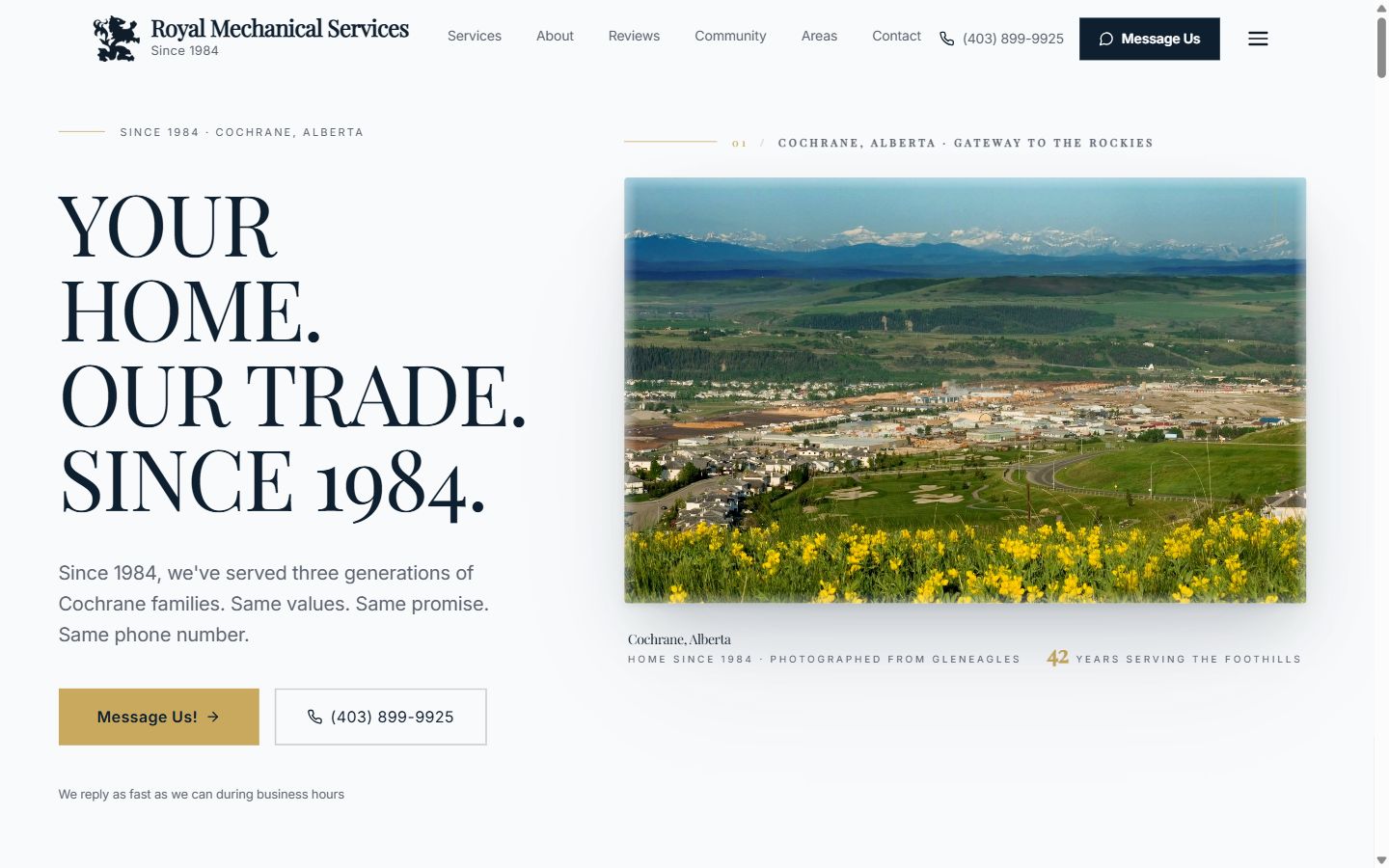
RoyalMechanicalServices.com is the website of Royal Mechanical Services, a family-run heating, cooling and plumbing company serving Cochrane, Alberta since 1984. Local Cochrane Web Design planned and built the current site. The strategy is simple to state and hard to fake: a clean, call-first front end backed by a deep service and service-area architecture, built to turn urgent local searches into confident calls and messages.
A furnace quits at eleven on a January night in Cochrane. The homeowner is cold, on their phone, scrolling past three search results — and any website that makes them stop and think has already lost the call. That is the exact situation this website was designed for, and this article walks through how, feature by feature.
Full disclosure before the teardown: Royal Mechanical Services is our client. We planned and built the website discussed here, and this article links to the live site and to our own custom web design for Cochrane and Alberta service businesses. What follows is the reasoning — read it, judge it, steal it for your own build.
The short answer
- One job: turn urgent local searches into confident calls and messages.
- Simple front end, deep service and service-area architecture underneath.
- Trust loads first: Since 1984, family-run, Cochrane-local, proof before style.
- Service-area pages answer real local questions — never city-name swaps.
- No AI tricks: crawlable, evidence-rich pages are what get found and cited.
The website had one job: turn urgent intent into confident contact
Every decision on RoyalMechanicalServices.com serves one commercial job: a stressed local visitor must confirm they have found the right company, for the right problem, in the right area — then call or message without friction. Five small decisions, made in seconds, decide whether an HVAC website earns the phone call.
- Right company? The name, trade and locality are the first things the eye lands on.
- Right service? Heating, cooling and plumbing are named in the customer's words, not trade jargon.
- My area? Cochrane and the surrounding communities are stated, not implied.
- Can I trust them? Forty years of history is visible before any design flourish.
- What do I do now? Call and message actions sit in reach at every scroll depth.
Every section of the build answers one of those five questions — nothing on the page exists for decoration. You can test this against the live site right now: open RoyalMechanicalServices.com on your phone and count the seconds until all five are answered.
A broken furnace does not care where your Contact page is
Urgent visitors do not hunt for a Contact page, so the build keeps a call action persistently in reach and breaks the message path into small, obvious steps. The interface reduces decisions at the exact moment the visitor has the least patience — without popups and without ever blocking the content.
- Pick the service — heating, cooling or plumbing, one tap, no typing.
- Add the details — a short field for the situation, not a wall of required boxes.
- Send it — with a clear sense of what happens next, or skip the form and just call.
The order matters. Asking for the service first means the enquiry arrives pre-sorted, and the visitor never faces a blank “Message” box at a stressful moment. The phone number stays visible throughout, because for a no-heat call at midnight the form is the backup, not the plan.
We moved forty years of trust into the first screen
Royal Mechanical has served Cochrane since 1984, and the build treats that fact as the most valuable pixel on the page. The first screen answers risk before aesthetics: who the company is, what it does, where it works, why it can be trusted, and what to do next.
- Identity — the company name and trade, unmissable.
- Scope — heating, cooling and plumbing, stated plainly.
- Locality — Cochrane and area, in words, not just a map pin.
- Proof — “Since 1984” and the family story carried from the company's own history.
- Action — a call and a message path inside the first screen.
A forty-year reputation used to live entirely offline — in trucks, word of mouth and repeat customers. The website's job was to make a stranger feel that history in about forty seconds. The condensed version of this project lives in the concise Royal Mechanical website case study; this article is the long-form reasoning behind it.
We organized the site around customer problems, not trade jargon
Nobody searches for “mechanical services” when their house is cold. The site's structure starts from the customer's problem — no heat, no cooling, a leak, bad air — and routes each one to a specific service path, so the visitor never has to translate trade language into their emergency.
| The customer's problem | Where the site routes it | Why it works |
|---|---|---|
| No heat in January | Heating — furnace repair and replacement | Matches the words a cold homeowner actually types |
| Sweltering July upstairs | Cooling — air conditioning services | Seasonal urgency gets its own front door |
| Leaking tank or dripping line | Plumbing — repair and installation | One tap separates water problems from air problems |
| Stuffy rooms, dusty vents | Air quality and ventilation | Names the symptom, then explains the fix |
| A building, not a bungalow | Commercial services | Keeps business enquiries from clogging residential paths |
Each path then breaks into its specific sub-services, so a furnace repair, a replacement and a maintenance visit each have a page that answers that exact job. This is the discipline most service sites skip, and it is the core of custom website planning for service businesses: structure follows the customer's decision, not the org chart.
The service-area pages are built to answer local questions — not swap city names
A service-area page earns its place only when someone from that community would find it specifically useful. Each of Royal Mechanical's area pages carries real local context, its own service relevance and links to nearby communities — the difference between a helpful local page and the doorway spam Google penalizes.
- ☐ Real local context — the community, its housing stock, its conditions, in words that only fit that place
- ☐ Service relevance — what the company actually does there, not a copied service list
- ☐ Distinct purpose — one page per genuine local job, never one page per keyword variant
- ☐ Nearby-area links — honest geography that helps the visitor and the crawler
- ☐ A path to proof — the same trust signals the rest of the site carries
The live examples show the range: a service-and-town page like Cochrane furnace repair does a different job than a community page like Arbour Lake, and a rural page like Madden or Redwood Meadows has to talk about different homes, distances and conditions than a city suburb. If those pages read identically, they would be doorway pages. They do not — and that is deliberate, the same discipline behind our local SEO architecture for Cochrane businesses.
Mobile-first means the job can be requested with one thumb
Most urgent HVAC searches happen on a phone, often one-handed. The build treats the thumb as the primary input: large tap targets, a call action inside the thumb's reach, a short form, no layout shift and nothing that covers the content while the visitor is deciding.
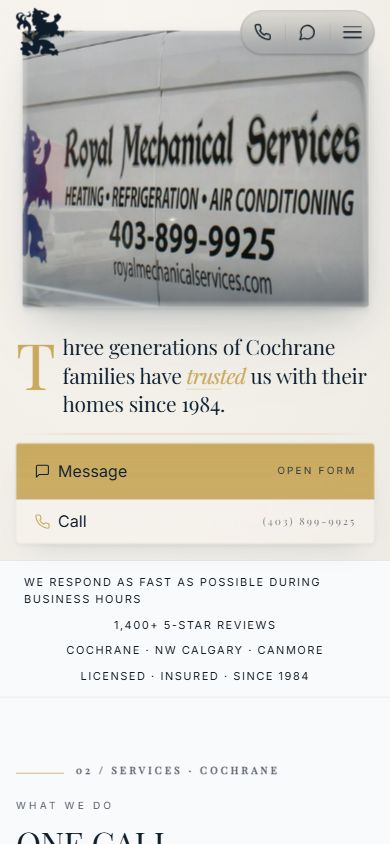
- ☐ Tap targets sized for thumbs, with the call action always within reach
- ☐ A message form short enough to finish standing in a cold hallway
- ☐ No popups, overlays or chat widgets blocking the content
- ☐ A stable layout — nothing jumps while the visitor is aiming a tap
- ☐ Tested on real phones, not just a resized desktop browser
Search visibility was engineered into the structure
Nothing about the site's search performance relies on tricks. Visibility is structural: readable URLs, crawlable HTML, one clear job per page, internal links that describe their destinations, and a sitemap that tells search engines exactly what exists. Structure is the part of SEO a build either gets right or retrofits expensively.
- Readable URLs that say what the page is, to humans and crawlers alike
- Real HTML — content and links present in the served page, not injected afterwards
- One job per URL — so no two pages compete for the same search
- Descriptive internal links connecting services, areas and proof
- Sitemap and canonical hygiene so the index matches the architecture
For owners with an existing site, this is the part that goes wrong most often during a rebuild: URLs change, redirects are skipped, and rankings that took years to earn disappear in a week. It is why website redesign and search-safe migration is a discipline of its own, not an afterthought.
AI search does not need magic markup. It needs useful evidence.
There is no special schema that makes Google's AI features or ChatGPT recommend a company. AI systems cite pages that are indexed, crawlable, genuinely useful and rich in first-hand evidence — the same qualities good SEO already requires. Anyone selling a secret AI markup trick is selling the absence of one.
- Indexed and crawlable — AI systems cannot cite what they cannot read
- Entity clarity — the same company name, trade and locality, everywhere
- Original evidence — real photos, real history, real service detail, not commodity text
- Specific answers — pages that resolve one question cleanly are what get quoted
- No guarantees — nobody controls inclusion, and honest providers say so
This build earns its AI-search footing the boring way: the architecture above, plus evidence on every page. That is also exactly how we scope AI search optimization for local businesses — as an extension of real SEO, never a replacement for it.
The site qualifies leads instead of collecting random messages
A website that just collects messages creates work; one that qualifies them creates revenue. Because the enquiry flow asks for the service first, every lead arrives pre-sorted, and measurement can distinguish a booked furnace call from a tire-kicker — without publishing a single invented statistic.
| What to measure | Why it matters |
|---|---|
| Calls and tap-to-call | The primary conversion for urgent work |
| Message starts vs completions | Reveals exactly where the form loses people |
| Service selected per enquiry | Shows which lines of business the site actually feeds |
| Area of the enquiry | Tests whether service-area pages pull their weight |
| Lead fit and follow-up quality | The number the owner actually cares about |
You will notice what is missing from this article: percentage lifts and traffic curves. We do not publish a client's numbers without approval, and we do not invent them. Define the measurement first — the results conversation becomes honest by construction.
What HVAC owners should steal from this build
The strategy transfers to any HVAC, plumbing or home-service company, without copying a single pixel: answer the five urgent-visitor decisions on the first screen, structure the site around customer problems, earn every service-area page, and measure calls — not compliments. Here is the checklist.
- Put identity, trade, locality, proof and a call action in the first screen.
- Name services in the customer's problem language, one page per distinct job.
- Keep a call action persistently in reach; make the form the backup, not the toll gate.
- Build only service-area pages a local would find specifically useful.
- Design for one thumb on a phone before any desktop flourish.
- Make visibility structural: readable URLs, crawlable HTML, descriptive links.
- Measure calls, message completions and lead fit — and let the data drive changes.
One more thing worth stealing: hold your web designer to the same evidence standard this article uses. Ours is public — a 5.0 average across 8 Google reviews of VeePo, the studio behind Local Cochrane Web Design, and every project linked live from our work page.
“VeePo did an awesome job creating my website. I haven’t had any issues or concerns. They are great! Definitely would recommend to anyone needed to build or fix their website!”
“Veepo turned my vision of a website into a reality! Parker was personable, insightful and all around easy to work with. I would highly recommend them for companies of any size and niche!”
Video testimonial: Client video testimonial — Caden Steinke, Flex Services.
What happens next
If you run an HVAC, plumbing or home-service company and your website is not producing calls, the useful next step is a written one: ask for an HVAC Website Opportunity Map — a short, specific diagnosis of where your current site leaks calls, which service and area pages are missing, and the three fixes to make first.
The Opportunity Map covers the same ground as this teardown, applied to your business: conversion friction on the urgent path, missing trust elements, priority service pages, priority service areas, thin-page risks, mobile contact friction, and search and AI-visibility gaps. It arrives in writing, with the next three actions in priority order — and if you want the numbers first, start with what a custom business website costs.

Frequently asked questions
Who built RoyalMechanicalServices.com?
Local Cochrane Web Design, a web design studio based in Cochrane, Alberta, planned and built the current Royal Mechanical Services website. Royal Mechanical is a disclosed client of the studio. The project covered strategy, design, development, lead capture and the local search architecture described in this article.
How many pages should an HVAC website have?
Enough useful, canonical pages to answer every distinct service, location and decision question your customers actually have — and no fixed number beyond that. A five-page site is too small for a multi-service local company; a hundred near-identical town pages is spam. Each page must earn its place with a distinct job.
Do service-area pages help local SEO?
Yes, when each page contains distinct, useful local information and genuine service relevance for that community. Pages that only swap the city name are doorway pages, which Google's spam policies target directly. The test: remove the town name, and something specifically local must remain on the page.
How can an HVAC website appear in Google AI features?
By being indexed, crawlable, genuinely useful and rich in first-hand evidence — the same foundations normal Google Search requires. Google's own guidance points to helpful, people-first content rather than any special markup. No provider can guarantee inclusion in AI features, and honest ones say so plainly.
How can an HVAC company become visible in ChatGPT?
Allow AI crawlers in robots.txt, serve real crawlable HTML, keep the business name, trade and service area consistent everywhere, and publish specific, evidence-backed pages worth citing. AI assistants draw on what they can read and verify. Nobody can promise a mention — treat any guarantee as a red flag.
Is this blog the same as the Royal Mechanical case study?
No. The case study is the concise portfolio summary — what was delivered and where it stands. This article is the educational teardown: the feature-by-feature commercial reasoning behind the build. They cross-link, cover different jobs, and neither replaces the other.
Sources
- Google Search Central — creating helpful, reliable, people-first content
- Google Search Central — AI features and your website
- Google Search Central — spam policies (doorway pages and scaled content)
- Better Business Bureau — Royal Mechanical Service Ltd., Cochrane AB
- Cochrane & District Chamber of Commerce — Royal Mechanical Services Ltd.
Get a written website plan — tell us about your HVAC or home-service business and ask for the HVAC Website Opportunity Map — a written, itemised plan comes back within one business day.